PVC Profile Extrusion Line: Main Machines and Their Functions
A PVC profile extrusion line is used to produce different types of PVC profiles for construction, furniture, decoration, and other applications. Common products include PVC window and door profiles, skirting boards, decorative profiles, and other plastic profiles.
A complete PVC profile extrusion line usually includes a feeding system, extruder, extrusion die, vacuum calibration table, cooling system, haul-off machine, cutting machine, and stacking rack. Each machine has its own function, and all parts work together to produce profiles with the required shape, size, and surface quality.
In this article, we will introduce the main machines in a PVC profile extrusion line and explain how they work during production.
1. Feeding System
The feeding system transfers PVC raw materials into the extruder. Before production, PVC resin is usually mixed with stabilizers, processing aids, pigments, and other additives according to the product requirements.
A stable feeding system helps supply materials continuously and supports consistent production. Depending on the production setup, the line may use manual feeding, a screw feeder, or an automatic feeding system.
2. PVC Profile Extruder
The extruder is one of the most important machines in a PVC profile extrusion line. It heats, mixes, and plasticizes the PVC material before pushing it toward the extrusion die.
Twin screw extruders are widely used for PVC profile production because they provide good mixing and are suitable for processing PVC formulations. The extruder model and screw design should be selected according to the profile size, material formula, and required output.
Stable temperature control and proper screw configuration help maintain consistent material processing.
3. Extrusion Die
The extrusion die gives the melted PVC material its initial profile shape. The die design depends on the cross-section and dimensions of the final product.
For example, a PVC window profile requires a different die from a PVC skirting board or decorative profile. The internal flow channels and die opening must be designed to distribute the material evenly.
A properly designed die helps improve dimensional consistency and surface quality. If a manufacturer wants to produce different profile shapes, separate dies may be required.
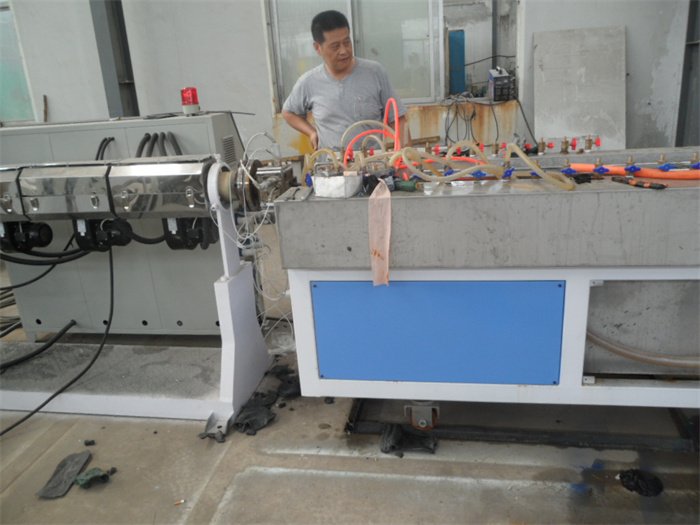
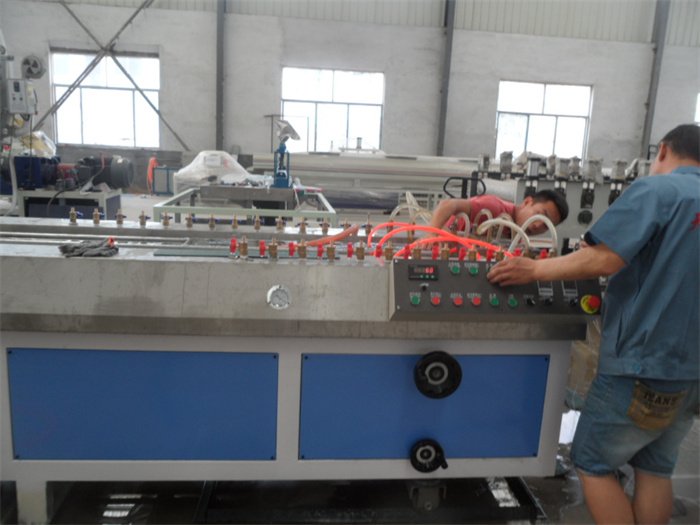
4. Vacuum Calibration Table
After leaving the die, the hot PVC profile enters the calibration section. A vacuum calibration table helps the profile reach and maintain its required dimensions while cooling.
Vacuum calibration is especially important for profiles with complex cross-sections, such as PVC window and door profiles. The calibration system must match the profile design to support stable shaping.
The calibration table may include vacuum pumps, water circulation, and temperature control systems. Proper adjustment helps reduce deformation during the early cooling stage.
5. Cooling System
Cooling removes heat from the extruded profile and helps it maintain its shape. Depending on the production line design, cooling may take place in the calibration table and additional cooling sections.
Uniform cooling is important because uneven cooling can cause bending, dimensional changes, or surface problems. The cooling system should be designed according to the profile dimensions, material characteristics, and production speed.
For thicker or larger profiles, sufficient cooling capacity is particularly important.
6. Haul-Off Machine
The haul-off machine pulls the profile through the calibration and cooling sections at a controlled speed.
A stable pulling force helps keep the profile moving smoothly and supports consistent dimensions. If the pulling speed is not properly matched with the extrusion output, the profile may become stretched, deformed, or uneven.
Different profile sizes and production requirements may call for different haul-off configurations. The traction system should provide stable movement without damaging the profile surface.
7. Cutting Machine
The cutting machine cuts the continuous PVC profile into the required lengths. The cutting length depends on the product specifications and the customer's production needs.
Depending on the line design, cutting may be controlled automatically according to a preset length. A suitable cutting system helps produce clean ends and consistent product lengths.
For profiles with different cross-sections, the cutting method and clamping structure should be selected carefully to prevent movement or surface damage during cutting.
8. Stacking Rack
After cutting, the finished profiles are transferred to a stacking rack for collection and handling.
The stacking rack helps organize the products and makes it easier for operators to move them to the next production stage, such as inspection, packaging, or storage.
For longer profiles or higher production speeds, an appropriately designed stacking system can improve handling efficiency and reduce manual work.
How Does a PVC Profile Extrusion Line Work?
The production process is relatively straightforward:
Raw Material Preparation → Feeding → Extrusion → Die Forming → Vacuum Calibration → Cooling → Haul-Off → Cutting → Stacking
First, the prepared PVC material enters the extruder, where it is heated and plasticized. The material then passes through the die to form the required profile shape.
Next, the hot profile enters the calibration and cooling sections. After the profile reaches sufficient dimensional stability, the haul-off machine pulls it forward at a controlled speed. The cutting machine then cuts it to the required length, and the finished profiles are collected on the stacking rack.
The performance of the complete line depends not only on each individual machine but also on how well the equipment is matched and adjusted.
How to Choose a Suitable PVC Profile Extrusion Line
Before purchasing a PVC profile extrusion line, manufacturers should consider several factors:
Product type: Window profiles, door profiles, skirting boards, and decorative profiles may require different machine configurations.
Profile dimensions: The size and cross-section affect the extruder model, die design, calibration system, and haul-off structure.
Required output: The production capacity should match the factory's manufacturing plan and market demand.
Automation level: Automatic cutting, feeding, and stacking systems can reduce manual handling.
Production flexibility: If different profile products will be manufactured, the line should be designed to accommodate the required dies and tooling changes.
Choosing the right equipment configuration can help manufacturers improve production stability and use factory space more efficiently.
Building a PVC Profile Production Line That Fits Your Needs
Every PVC profile extrusion line is designed around the products it needs to manufacture. The profile shape, material formula, production speed, and required output all affect the choice of equipment.
From the extruder and die to the calibration table, haul-off, and cutting machine, each part needs to work well with the others. Proper equipment matching helps maintain product quality and supports stable daily production.
Understanding the function of each machine makes it easier to plan a suitable production line for different PVC profile manufacturing needs.