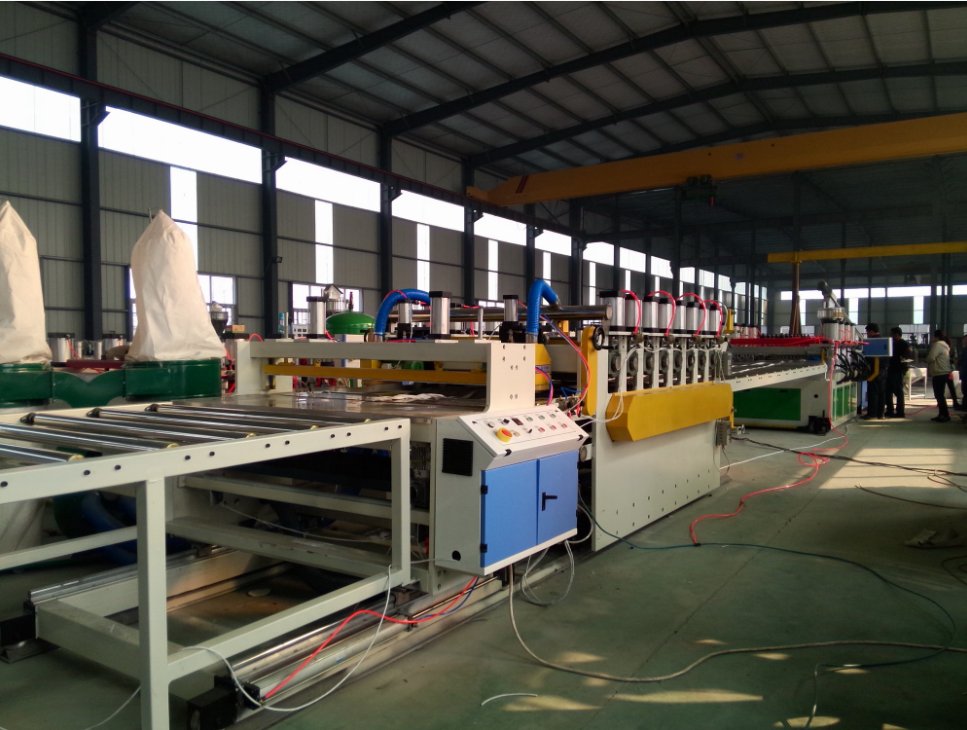


PVC Foam Board Production Line: Equipment and Production Process
1. Introduction to PVC Foam Board Production Line
PVC foam board is a lightweight plastic sheet made mainly from PVC resin. It has the advantages of low weight, good corrosion resistance, easy processing, and a smooth surface. It is widely used in advertising, furniture, interior decoration, construction, and display applications.
With the growing demand for lightweight plastic sheets, more manufacturers are investing in PVC foam board production lines. A well-designed production line can help improve production efficiency, maintain stable product quality, and reduce material waste.
Qingdao Aorui Plastic Machinery Co., Ltd. provides PVC foam board extrusion lines with complete equipment, including an SJSZ80×156 twin conical screw extruder, extrusion die, cooling and calibration system, haul-off machine, cutting units, and handling robot.
This article introduces the main equipment and explains the production process step by step.
2. Main Equipment of PVC Foam Board Production Line
A complete PVC foam board production line mainly consists of the following nine units.
1). SJSZ80×156 Twin Conical Screw Extruder
The extruder is the main machine of the production line. It transports, melts, and mixes the PVC material to prepare it for extrusion. The twin conical screw design is suitable for processing PVC materials and helps provide stable plasticizing performance under proper operating conditions.
2). Extrusion Die
The extrusion die distributes the melted material and forms it into a continuous board shape. The die design and temperature settings affect the board's width, thickness, and surface quality. A suitable die should be selected according to the required product specifications and production process.
3). Cooling and Calibration Platform
After leaving the die, the hot board enters the cooling and calibration platform. This unit helps control the board's shape, width, and thickness while cooling the material.
Proper calibration is important for producing boards with a smooth surface and consistent dimensions.
4). Two-Section Cooling Support Table
The two-section cooling support table supports the board and provides additional cooling. Gradual cooling helps improve dimensional stability and reduces the risk of bending or warping.
5). Side Trimming Unit
The side trimming unit removes uneven edges from the board. It helps produce clean edges and prepares the board for the next cutting process.
6). Eight-Roller Haul-Off Machine
The eight-roller haul-off machine pulls the board forward at a stable speed. Its multi-roller design helps provide steady traction and supports continuous production.
The haul-off speed must match the extrusion speed to avoid stretching, deformation, or thickness variations.
7). Longitudinal Cutting Machine
The longitudinal cutting machine cuts the board along its length to achieve the required width. Operators can adjust the cutting positions according to different product specifications.
8). Cross-Cutting Machine
The cross-cutting machine cuts the continuous board into pieces of the required length. Accurate cutting helps ensure consistent product dimensions and improves production efficiency.
9). Handling Robot
The handling robot helps pick up, move, or stack the finished boards, depending on the production line configuration. It reduces manual handling and improves the efficiency of the material transfer process.
3. PVC Foam Board Production Process
The complete production process includes raw material preparation, mixing, extrusion, cooling, cutting, inspection, and storage.
Step 1: Raw Material Preparation and Mixing
PVC resin, foaming agents, stabilizers, lubricants, and other necessary additives are prepared according to the product formula. These materials are mixed to achieve an even distribution before entering the extruder.
Step 2: Feeding and Plasticizing
The mixed material is fed into the hopper of the SJSZ80×156 twin conical screw extruder. Inside the extruder, the material is transported, heated, melted, and mixed to form a uniform melt suitable for extrusion.
Step 3: Extrusion and Board Forming
The melted material passes through the extrusion die and comes out in the required board shape. The foaming structure is formed according to the material formula, temperature, pressure, and processing conditions.
Step 4: Cooling and Calibration
The hot board passes through the cooling and calibration platform and then the two-section cooling support table. These units help cool the board, maintain its shape, and improve dimensional stability.
Step 5: Haul-Off and Side Trimming
The eight-roller haul-off machine pulls the board forward continuously. The side trimming unit removes uneven edges to prepare the board for final cutting.
Step 6: Longitudinal and Cross Cutting
The longitudinal cutting machine adjusts the board width, while the cross-cutting machine cuts it into the required lengths. This process produces boards that meet the customer's size requirements.
Step 7: Product Inspection and Handling
The finished boards are inspected for thickness, width, length, surface quality, and flatness. Qualified products are moved or stacked by the handling robot and then stored in the warehouse.
Step 8: Recycling of Scrap Material
Suitable edge trimmings and rejected boards can be crushed for material recovery. Recycled material should be evaluated and used according to the product requirements and processing conditions to maintain consistent board quality.
4. Key Factors Affecting PVC Foam Board Quality
The quality of PVC foam board depends on several factors, including raw material preparation, mixing quality, extrusion temperature, die design, foaming conditions, cooling performance, and haul-off speed.
For example, insufficient plasticizing may cause surface defects or uneven internal structures. Improper cooling may lead to warping or dimensional changes. An incorrect balance between extrusion speed and haul-off speed may also affect board thickness and shape.
Therefore, manufacturers should select suitable processing parameters according to the board type, thickness, density, and final application.
5. How to Choose a PVC Foam Board Production Line
Before purchasing a PVC foam board production line, manufacturers should consider the required board specifications, production capacity, product type, automation level, energy consumption, and maintenance requirements.
The equipment configuration should match the actual production needs. A suitable combination of extrusion, cooling, calibration, haul-off, cutting, and handling systems helps establish a stable and efficient production process.
Qingdao Aorui Plastic Machinery Co., Ltd. specializes in plastic extrusion machinery and complete production line solutions. We can provide suitable equipment configurations according to different customer requirements.
If you are looking for a PVC foam board production line, please contact Qingdao Aorui Plastic Machinery Co., Ltd. to learn more about our equipment, production processes, and available solutions for your business.