

PE Pipe Production Process Explained: From Raw Material to Finished Pipe
PE (Polyethylene) pipes are widely used in water supply, gas transportation, agricultural irrigation, drainage, and industrial fluid transportation. Their corrosion resistance, lightweight design, flexibility, and long service life make them a popular choice for many piping applications.
For customers planning to invest in a PE pipe manufacturing project, understanding the complete production process is important. Although the machine configuration may vary depending on pipe diameter, wall thickness, material, and production capacity, the basic PE pipe production process generally includes:
Raw Material Preparation → Extrusion and Plasticization → Pipe Forming → Vacuum Calibration → Cooling → Haul-Off → Cutting or Coiling → Inspection
So, how is a PE pipe manufactured? Let's take a closer look at the complete PE pipe extrusion process.
1. PE Raw Material Preparation
The main raw material for PE pipe production is polyethylene resin. Common materials include HDPE (High-Density Polyethylene) and other grades of polyethylene.
The material grade is selected according to the pipe's application and pressure requirements. For example, PE100 is widely used for water supply pipes, gas pipes, and other applications that require high strength and pressure resistance.
Before production, the raw materials are prepared according to the product requirements. For black PE pipes, carbon black masterbatch or pre-colored PE material can be used.
2. Extrusion and Plasticization
The prepared PE material is fed into the extruder through an automatic feeding system.
A single screw extruder is commonly used for PE pipe production. As the screw rotates, the material is continuously conveyed forward inside the heated barrel.
The heating system gradually raises the material temperature until the polyethylene melts. At the same time, the screw compresses, mixes, and plasticizes the material to produce a uniform PE melt.
Stable plasticization is essential for producing high-quality pipes. Improper temperature control or insufficient plasticization may cause problems such as an uneven surface, poor appearance, or inconsistent wall thickness.
3. Pipe Forming Through the Die
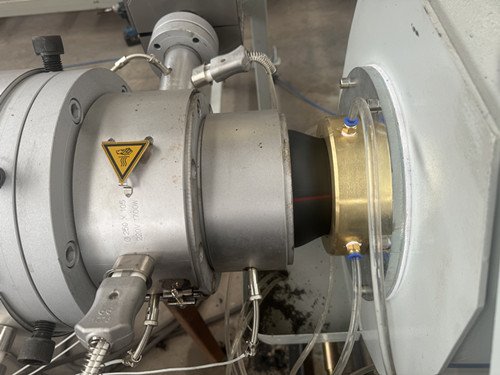
After the PE material is fully plasticized, the molten material is pushed through the pipe die head.
The die determines the basic shape and size of the pipe. Different pipe specifications require corresponding dies and calibration components.
For example, a PE pipe extrusion line can be configured to produce different sizes such as 20 mm, 32 mm, 63 mm, or 110 mm pipes.
At this stage, the molten PE has formed a tubular shape, but it is still hot and soft. The pipe must therefore pass through the calibration and cooling systems to achieve its final dimensions.
4. Vacuum Calibration
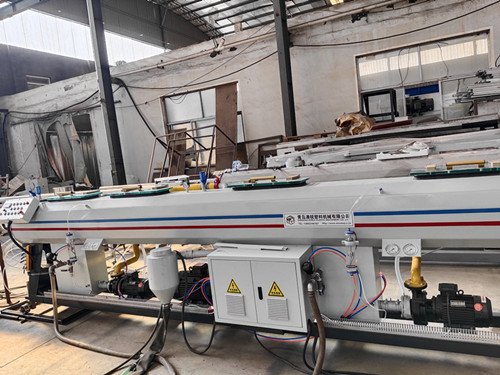
The hot pipe coming out of the die enters the vacuum calibration tank.
Vacuum calibration is one of the most important steps in the PE pipe production process. Negative pressure inside the tank helps the hot pipe fit closely against the calibration sleeve, allowing it to reach the required outside diameter.
Cooling water simultaneously removes heat from the pipe and helps stabilize its shape.
A properly designed vacuum calibration system is important for controlling the pipe's outside diameter, roundness, and dimensional accuracy.
5. Spray Cooling
After initial calibration, the pipe enters the spray cooling tank.
Cooling water is sprayed evenly onto the pipe surface through multiple nozzles, further reducing the pipe temperature and stabilizing its dimensions.
Large-diameter and thick-wall HDPE pipes generally require a longer cooling section because more heat needs to be removed before the pipe becomes fully stable.
The cooling capacity of the production line therefore has a direct influence on production speed and product quality.
6. Haul-Off
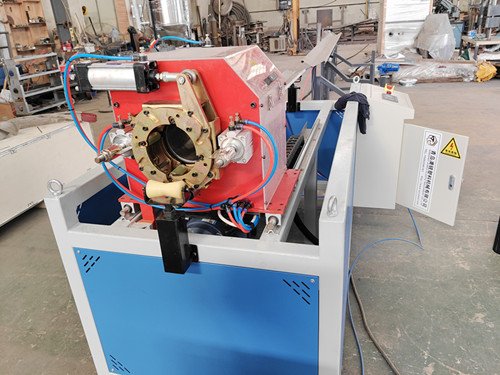
Once the pipe has been sufficiently cooled, it enters the haul-off machine.
The haul-off uses caterpillar tracks or other clamping structures to continuously pull the pipe forward.
The haul-off speed must be properly matched with the extrusion output. If the haul-off speed is too high, the pipe wall may become thinner. If it is too slow, the wall thickness may increase.
For this reason, the haul-off system plays an important role in maintaining consistent pipe dimensions during continuous production.
7. Inkjet Printing and Marking
An inkjet printer can be installed according to customer requirements.
The printer can mark important information on the pipe, such as:
Pipe size
Material grade
Pressure rating
Production date
Manufacturer or brand
Applicable standard
Meter marking
This information makes product identification easier and can also help manufacturers with production and quality traceability.
8. Cutting or Coiling
The final downstream equipment depends mainly on the pipe diameter and application.
For small-diameter PE pipes, such as irrigation pipes, an automatic winder can continuously coil the finished pipe.
For larger-diameter pipes, a cutting machine is normally used to cut the pipe into fixed lengths. Depending on customer requirements, pipes can be cut into 6 m, 9 m, 12 m, or other specified lengths.
9. PE Pipe Quality Inspection
After production, the finished pipes should be inspected according to the applicable product standards.
Common inspection items include:
Outside diameter
Wall thickness
Ovality
Surface appearance
Pipe length
Hydrostatic pressure performance
Tensile properties
Elongation at break
Carbon black content and dispersion, when applicable
The exact testing requirements depend on the material, pipe application, target market, and applicable standards.
For example, pipes used for drinking water, gas transportation, and pressure applications generally have stricter requirements than non-pressure pipes.
10. Main Equipment of a PE Pipe Extrusion Line
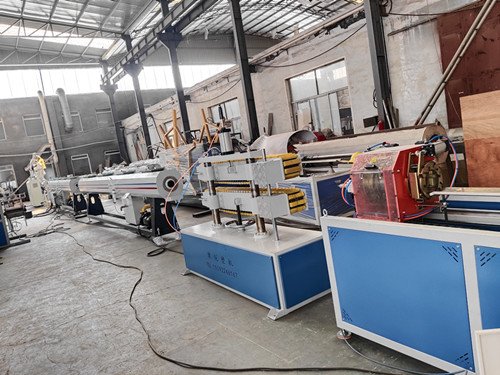
A complete PE Pipe Extrusion Line consists of several machines working together to complete the entire production process.
The main equipment normally includes:
Automatic Feeding System – transfers PE raw material to the extruder.
Single Screw Extruder – heats, melts, plasticizes, and extrudes the PE material.
Pipe Die Head and Die – forms the molten material into a tubular shape.
Vacuum Calibration Tank – controls the pipe diameter and roundness.
Spray Cooling Tank – further cools and stabilizes the pipe.
Haul-Off Machine – continuously pulls the pipe forward.
Cutting Machine – cuts the pipe into required lengths.
Automatic Winder – coils small-diameter PE pipes.
Inkjet Printer – prints product information on the pipe.
11. What Determines PE Pipe Production Speed?
One of the most common questions from customers is:
How many meters of PE pipe can a machine produce per hour?
Production speed is not determined by the extruder alone. It depends on factors such as pipe diameter, wall thickness, material grade, extruder capacity, screw design, die structure, cooling capacity, haul-off speed, and product standards.
Small-diameter and thin-wall PE pipes can generally be produced at higher speeds, while large-diameter and thick-wall HDPE pressure pipes require more material output and usually run at a lower production speed.
Therefore, when selecting a PE pipe extrusion machine, customers should focus on the required pipe specifications and actual production capacity rather than simply comparing the maximum machine speed.
12. How to Choose the Right PE Pipe Production Line?
Before purchasing a PE pipe production line, customers should first determine the target pipe specifications, such as 20–63 mm, 20–110 mm, 50–160 mm, 75–250 mm, or 110–315 mm.
It is also important to define the pipe application, required production capacity, pipe length or coiling method, and standards required in the target market.
Different applications may require different material grades, pressure ratings, testing equipment, and machine configurations.
Conclusion
PE pipe production is a continuous process involving material plasticization, extrusion, pipe forming, vacuum calibration, cooling, haul-off, and cutting or coiling.
A reliable PE Pipe Extrusion Line requires all major systems to work together smoothly. Stable extrusion, accurate vacuum calibration, sufficient cooling capacity, and precise haul-off control are all important for producing consistent and high-quality PE pipes.
If you are planning to establish a PE pipe manufacturing plant, the production line should be designed according to your target pipe sizes, material grade, required output, application, and local standards. A properly configured PE Pipe Extrusion Machine can provide an efficient and stable solution for producing PE and HDPE pipes for different markets and applications.